

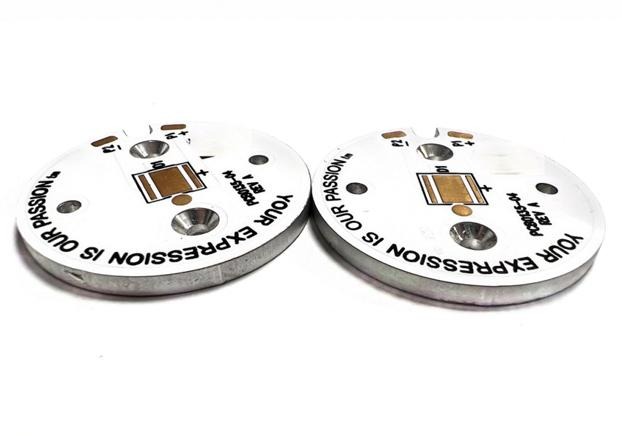
In the modern electronics landscape, heat is the ultimate enemy of performance and longevity. As components become smaller and more powerful, traditional fiberglass substrates often struggle to dissipate the thermal energy generated during operation. This challenge has led to the widespread adoption of the aluminum pcb. Known for its superior thermal conductivity and structural integrity, this specialized circuit board has become the gold standard for high-power applications, particularly in the lighting and automotive sectors.
What Exactly is an Aluminum PCB?
An aluminum pcb, also referred to as a Metal Core PCB (MCPCB), is a unique thermal management design consisting of a thin layer of thermally conductive but electrically insulating dielectric material, laminated between a copper circuit layer and an aluminum metal base.
Unlike a standard FR-4 board that relies on the plastic substrate to handle heat, the aluminum pcb uses its metallic backbone to pull heat away from critical components and disperse it into the surrounding environment or a secondary heat sink.
The Anatomy of the Board
To understand why an aluminum pcb performs so well, we have to look at its layered construction:
- Circuit Layer (Copper Foil): This is where the electrical traces are etched. It is similar to the copper layer on a standard board but often thicker to handle higher current loads.
- Dielectric Layer: This is the “secret sauce” of the aluminum pcb. It is a specialized polymer layer that provides electrical insulation while maintaining high thermal conductivity. It must be thin enough to transfer heat efficiently but robust enough to prevent short circuits.
- Base Layer (Aluminum Substrate): Usually made of 3003 or 5052 aluminum alloys, this layer provides mechanical stability and acts as the primary thermal mass for heat dissipation.
Why Choose an Aluminum PCB?
Engineers opt for an aluminum pcb when thermal demands exceed the capabilities of traditional materials. The benefits extend far beyond just cooling:
1. Superior Heat Dissipation
The most obvious advantage is thermal regulation. High-power LEDs and power converters generate intense heat in a concentrated area. An aluminum pcb can transfer heat up to 10 times more efficiently than a standard FR-4 board, preventing component burnout and “thermal runaway.”
2. Enhanced Durability
Aluminum is a rugged material. It provides a level of mechanical strength that ceramic or fiberglass substrates simply cannot match. This makes the aluminum pcb ideal for applications subject to high vibration or mechanical stress, such as aerospace or industrial machinery.
3. Dimensional Stability
Under extreme temperatures, standard boards can warp or expand, putting stress on solder joints. Aluminum has a very low rate of thermal expansion, meaning the board maintains its shape and integrity even when the environment gets hot.
4. Lightweight and Sustainable
Despite its strength, aluminum is incredibly light. Furthermore, it is a highly recyclable metal, making the aluminum pcb a more environmentally friendly choice for manufacturers looking to improve their “green” credentials.
Common Applications
The versatility of the aluminum pcb has allowed it to dominate several high-growth industries:
- LED Lighting: This is the most common use case. From streetlights to household bulbs and theatrical lighting, LEDs require constant cooling to maintain their brightness and color accuracy.
- Automotive Systems: You will find an aluminum pcb in power regulators, ignition systems, and modern electric vehicle (EV) motor controllers.
- Power Supplies: Switched-mode power supplies and DC-DC converters utilize metal cores to manage the heat generated by power transistors.
- Audio Equipment: High-power amplifiers often use aluminum bases to keep the output circuitry cool during heavy usage.
Design Considerations for Engineers
Designing an aluminum pcb requires a slightly different mindset than standard PCB design. Since the base is conductive metal, you cannot create traditional “through-hole” components that pass through the board without specialized (and expensive) insulation. Consequently, almost all aluminum pcb designs are Surface Mount Technology (SMT) only.
Furthermore, designers must account for the “creepage and clearance” distances more strictly. Because the metal base is so close to the copper traces, the dielectric layer must be of the highest quality to prevent electrical arcing, especially in high-voltage power applications.
Conclusion: Finding the Right Production Partner
The shift toward higher efficiency and smaller footprints in electronics isn’t slowing down. As we pack more power into tighter spaces, the aluminum pcb remains the most cost-effective and reliable solution for thermal management. However, because the manufacturing process involves bonding dissimilar materials (metal and polymer), precision is paramount. A poorly manufactured dielectric layer can lead to catastrophic failure in the field.
To ensure your product stands the test of time and temperature, it is vital to work with a reputable aluminum pcb manufacturer. A manufacturer with specific expertise in metal-base laminates can help you optimize your stack-up, select the right thermal conductivity ratings, and ensure that your final product is both thermally efficient and mechanically sound.