

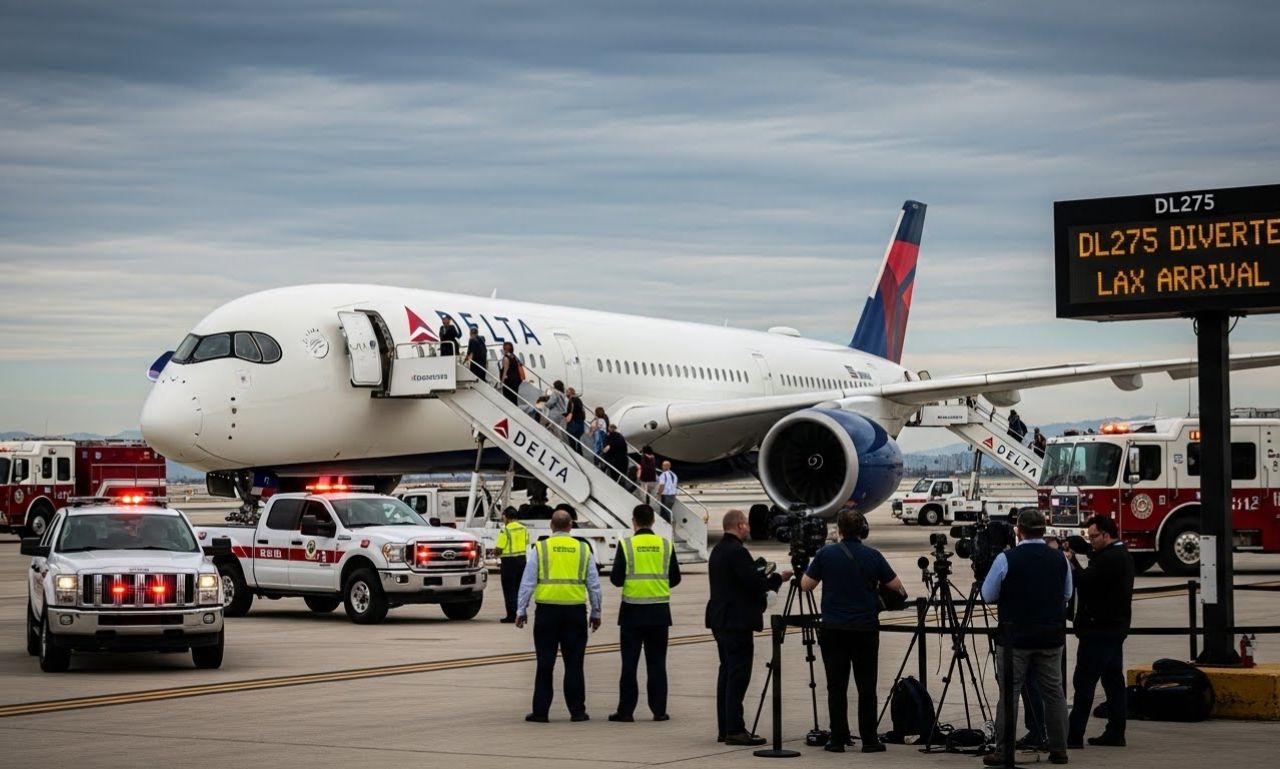
On May 27, 2025, Delta Air Lines Flight DL275 operating on the Detroit (DTW) to Tokyo Haneda (HND) route diverted unexpectedly to Los Angeles International Airport (LAX). This Delta flight DL275 diverted LAX incident saw a long-haul Airbus A350-900 (Reg. N508DN) make an emergency landing early the next morning. Passengers and crew had planned a 13-hour trip across the Pacific, but a mid-air safety issue forced the change of course. The flight landed safely on LAX’s Runway 06R around 01:08 AM local time. Thanks to quick action by the pilots and robust airport facilities, everyone on board remained safe.
To make sense of what happened, here’s a snapshot of the key flight details:
| Flight Detail | Information |
|---|---|
| Flight Number | DL275 (also seen as DL 275, DL0275, or Delta 275) |
| Date | May 27–28, 2025 |
| Route (Scheduled) | Detroit (DTW) → Tokyo Haneda (HND) |
| Aircraft | Airbus A350-900 (Reg: N508DN) |
| Original Duration | ~13 hours |
| Diverted To | Los Angeles (LAX) – Ran on Runway 06R |
| Time in Air | ~12 hours 15 minutes (including diversion) |
| Diversion Reason | Engine anti-ice system malfunction |
| Injuries | None reported |
What Happened on Flight DL275?
Delta Flight DL275 typically departs Detroit in the afternoon and flies nonstop to Tokyo, cruising over Alaska and the North Pacific before landing early the next morning. On May 27, 2025, the Airbus A350-900 took off normally from DTW at about 3:53 PM local time. Passengers settled in for the overnight journey. A few hours into the flight, over the remote Bering Sea (about 620 nautical miles southwest of Anchorage, Alaska), something went wrong.
At around cruising altitude (38,000 feet), the flight crew detected a fault. According to reports, an aircraft sensor flagged an irregularity, and the pilots began running checklists and communicating with air traffic control. Passengers later reported that the captain announced an issue with the plane’s engine anti-ice system. Rather than continue across the ocean toward Tokyo, the crew made a decisive call: turn around and divert to a safe airport.
Instead of heading back to Detroit or trying nearby alternates like Anchorage or Seattle, DL275 flew south to Los Angeles landing on LAX’s runway 06R in the early hours of May 28, 2025. The change was sudden for passengers: what was supposed to be a Japan-bound flight ended with an unexpected touchdown in California. Flight trackers even showed queries like “Delta flight DL275 diverted LAX today” trending as people searched for answers.
Key facts and observations about the diversion:
- Early Detection: While over the North Pacific, the crew saw a rolls-royce Trent XWB engine anti-ice system fault. This system prevents ice buildup on the engine inlet at high altitudes.
- Quick Decision: The pilots didn’t delay. They secured the affected system, communicated with ATC, and identified the nearest suitable diversion field.
- Turnaround & Flight Time: DL275 turned around and flew roughly 5 hours back toward the U.S. mainland. In total, the flight time was about 12 hours 15 minutes — almost as long as the scheduled Detroit–Tokyo trip.
- Safe Landing: LAX handled the emergency landing smoothly at ~1:08 AM PDT on May 28, 2025. Emergency crews were on standby, but the touchdown was uneventful.
- No Injuries: Importantly, no passengers or crew were injured. The cautious decision ensured everyone remained safe throughout.
Why DL275 Diverted to LAX
Diversions usually happen to protect safety, not because of panic. In this case, the culprit was a mechanical issue: the engine anti-ice system on the Airbus A350. This system uses hot bleed-air (from the engine’s high-pressure compressor) to heat the engine inlet and prevent ice buildup. At 38,000 feet, ice can form on engine parts if this heating fails, risking engine performance or damage. When the anti-ice valves or sensors flag a fault, pilots treat it seriously. As one account notes, “a malfunction in the Rolls-Royce Trent XWB engine’s anti-ice system posed serious risks to flight safety”.
Engine issues are among the top diversion triggers. Other causes include medical emergencies, severe weather, or security problems. In DL275’s case, continuing to Tokyo without anti-ice could have been dangerous. With the Pacific ahead, the crew chose caution. They could have turned back to Detroit, but by then they were already near U.S. West Coast airspace.
Why Los Angeles (LAX)?
At first glance, LAX seems far south for a Detroit-origin flight. However, LAX is a major international hub with vast emergency handling capability. It has long runways (suitable for fully-loaded A350s), heavy-duty ground equipment, and a large Delta operations base. Notably, Delta has extensive maintenance facilities and spare parts stock there. There’s even a Rolls-Royce maintenance center on-site for the Trent XWB engines. In short, LAX had everything needed for an aircraft in distress:
- Infrastructure: LAX can easily handle a wide-body A350 in an emergency. Its long runways and 24/7 emergency services minimize risk during landing.
- Delta Presence: Delta operates many flights through LAX. This means gates, mechanics, and customer service teams are readily available. Crew can more easily rebook passengers onto flights to Asia from LAX than from a smaller airport.
- Technical Support: Crucially, LAX houses parts and specialists. At such an altitude, the anti-ice system is vital; LAX’s engineering base (and even a dedicated Rolls-Royce support team) was the best place for diagnostics.
- Passenger Services: LAX has customs, hotels, and transport on standby. An unexpected overnight stay is less chaotic in a well-equipped hub.
Timeline of the Emergency Diversion
Putting the pieces together, here’s how the DL275 diversion unfolded step by step:
- 15:53 (May 27, 2025, EDT) – Depart DTW. The Airbus A350-900 (Reg. N508DN) takes off from Detroit for Tokyo. It is slightly delayed by late arriving equipment, but otherwise departs normally.
- Early Cruise (May 27) – Routine flight. DL275 climbs over North America toward the Pacific. Cabin lights dim for dinner; many passengers prepare to sleep.
- ~21:00 UTC (Date Line, North Pacific) – Issue detected. Over the remote Bering Sea at FL380, a sensor flags the engine anti-ice system. Crew runs checklists and consults with ATC. Passengers hear an announcement about an unspecified “operational issue.”
- Decision to Divert – Course change. Realizing the situation and the lack of nearby emergency airports, pilots decide on Los Angeles. The aircraft turns southeast (rather than retracing all the way back to Detroit).
- Redirection (May 27–28) – En route to LAX. DL275 spends about 5 hours reversing course and flying toward California. (It roughly retraces much of its path over the Pacific.) Meanwhile, the cabin crew continuously updates passengers with whatever information is available.
- ~01:08 AM PDT (May 28) – Touchdown at LAX. The A350 lands safely on Runway 06R, about 12 hours 15 minutes after departure. Emergency vehicles line the runway, but the landing is smooth.
- Immediately After – Airport response. Fire trucks and rescue teams move in as a precaution. Mechanics begin inspecting the engine. Passengers stay seated until cleared.
- 01:30–02:00 AM – Deboarding. Once on the gate, passengers disembark normally. Ground staff meet the aircraft: medics stand by, and airline staff prepare to assist.
- Post-Landing – Behind-the-scenes. Delta engineers team up with Rolls-Royce specialists to diagnose the anti-ice fault. The aircraft remains grounded at LAX for roughly 18–19 hours before returning to service.
The Engine Anti-Ice Malfunction
To understand the root cause, let’s break down what engine anti-ice means. At high altitudes, especially over polar regions, ice crystals and supercooled water droplets can cling to aircraft surfaces. On engines, this is deadly. Modern jets like the A350 use hot bleed air from the engine compressor to heat the inlet and prevent ice from forming. In practice, when the system is ON, valves route hot air (from the 3rd stage of the high-pressure compressor) through rings or ducts at the engine’s front. This warmth keeps the inlet clear.
On DL275, something in that anti-ice system failed mid-flight. Passengers later reported the captain saying, “engine anti-ice.” Specifically, either a valve jammed or a pressure valve acted up (the records say one of the anti-ice valves was abnormally open). With the system compromised, continuing the long flight meant risking engine icing.
In simple terms, it’s like driving on an icy road without snow chains. On the ground, planes get sprayed with de-icing fluid before takeoff, but that doesn’t protect engines in the sky. At altitude, crews must use anti-ice to stay safe. Once that system showed a fault, the safest action was to land as soon as practicable.
The pilots handled it perfectly. They identified the issue, informed ATC, and followed the airline’s emergency checklists. Cabin crew reassured passengers, made announcements about diverting, and prepared the cabin. Flight attendants kept the mood calm, answering questions quietly and ensuring everyone had their seatbelts on during the descent. By treating the event as a precaution rather than a panic, the crew turned a potential crisis into a textbook diversion.
Why LAX Was Chosen
Many outside aviation might wonder: why not a closer alternate like Anchorage or even returning to Detroit? The answer lies in what an airport can offer. When the DL275 crew considered options, LAX had clear advantages:
Emergency Readiness
LAX has one of the longest runways in the U.S. and robust rescue fire teams on call. For a heavy A350, a long, high-strength runway is a must if any system is suspect. LAX provides that.
Technical Facilities
Delta’s maintenance base at LAX is top-notch. Crucially, there are on-site experts and spares for the A350 and its engines. In fact, LAX has dedicated Rolls-Royce technicians for the Trent XWB. The Airbus was able to land and immediately begin diagnostics without waiting for specialized help to arrive.
Weather & Routing
That night, Los Angeles had good weather (clear skies, mild winds). While Anchorage or Seattle were geographically closer, their weather can be unpredictable. Pilots prefer a stable weather airport when dealing with an emergency.
Passenger Logistics
LAX is a major international hub, meaning hotels, customs, and onward flights are readily accessible. Delta operates multiple daily flights LAX→Tokyo, so rebooking was more straightforward. The airport staff could also quickly arrange hotel rooms and meals. LAX’s Delta hub has staff accustomed to handling irregular arrivals.
Flight Plan Efficiency
From a network standpoint, sending DL275 to LAX minimized subsequent delays. Delta could swap in another aircraft from LAX’s fleet for Seattle-Tokyo routes, rather than trying to insert a Tokyo-bound flight far from a hub.
Passenger Experience on the Diverted Flight
For travelers on DL275, the diversion was undoubtedly disorienting. Imagine being in row 30, drifting to sleep, and waking to an announcement: “Ladies and gentlemen, we will be landing in Los Angeles out of an abundance of caution.” Many passengers naturally grew anxious. Reports suggest a mix of reactions: some were alarmed and silently prayed, while others remained calm, trusting that the experienced crew was doing everything right.
In-flight:
The cabin crew became the face of reassurance. Flight attendants regularly communicated updates as they got them. They explained in simple terms that the landing was precautionary and that everything was under control. While specifics (like “engine anti-ice malfunction”) are often not shared in detail mid-flight, crews did mention it was a technical issue, not a passenger emergency. This minimized panic.
They also prepared everyone for the early descent: checking seatbelts, securing loose items, and making sure electronic devices were off for landing. Because the flight was trans-Pacific, most had been served dinner and were perhaps expecting to sleep the sudden change meant turning lights on and staying awake during landing. The crew offered water and stayed attentive, understanding that passengers might be frightened or upset.
After landing at LAX
The cabin lights came up fully. Emergency vehicles scurried alongside, but no fire engine sprayed the plane, since it was just a precaution. The pilot announced once more that the issue was contained and inspected, and thanked passengers for their patience. People clapped quietly upon touchdown a common sign of relief on diversions.
Once at the gate, passengers disembarked normally. No one had to slide out in emergency mode; it was a calm deplaning. In the terminal, Delta representatives met them. Here’s how Delta assisted:
- Rebooking & Accommodations: Many passengers had connecting flights to Tokyo or elsewhere. Those missed connections were immediately rebooked on flights departing in the next day or two. Delta provided hotel rooms, meal vouchers, and transportation to compensate for the unexpected overnight stay.
- Communications: Airlines typically allow affected travelers to make phone calls or send emails home. Many likely notified family or hotels of the change.
- Support Services: Baggage handlers worked to ensure checked luggage made it to the new flights. For those with medical needs (e.g. insulin refrigeration), airport medics and staff offered assistance.
- Information: Social media and news reports were already buzzing with the story. Delta staff were present to answer questions at service desks and via phone support.
Passengers took to Twitter and forums. Remarkably, despite the stress, most posts were positive. Travelers commended the pilots’ calm announcements and the crew’s handling of the situation. Typical tweets praised the professionalism and said how surprised they were that the diversion went so smoothly. Of course, some vented frustration about the delay (losing a night’s sleep, missing a day of work), but overall the tone was understanding. Many recognized better safe than sorry and were just glad no one was hurt.
Landing and Aftermath at LAX
The ground response at LAX followed standard emergency protocols:
- Runway Preparation: The tower cleared Runway 06R and summoned fire/rescue trucks to standby. LAX dispatch coordinated spacing to accommodate the A350’s approach.
- Controlled Descent: Air traffic controllers gave DL275 a direct path to LAX. Because it was so heavy with fuel (due to the long flight), the pilots performed a green (long) landing: a steady, firm touchdown to avoid excess braking.
- Engine-Off and Evacuation: Upon exit, engines were shut down as the aircraft slowed. Fire crews inspected the plane externally before allowing passengers to leave. This inspection is routine: they make sure no fire or damage is visible.
- Gate Arrival: DL275 pulled into a wide-body gate normally assigned to Delta. On arrival, the wheels-stop time was about 01:10 AM local.
Once at the gate, ground handling took over. Baggage carts were positioned, and a belt loader began offloading cargo. Importantly, no rapid evacuation was needed, so passengers disembarked in an orderly fashion, one door at a time.
Meanwhile, on the tarmac:
- Maintenance Teams: Delta’s engineers met the plane. They brought out diagnostic equipment to test the faulty anti-ice system. Rolls-Royce specialists joined (they often station techs at major hubs like LAX).
- Safety Checks: The crew logged the incident in the aircraft logbook. This entry would trigger deeper inspections before the A350 flies again.
- Luggage & Connections: Handlers sorted luggage onto two streams: one for passengers catching immediate onward flights, and another for checked bags heading to their original destinations (Tokyo or elsewhere) later.
Inside the terminal:
Delta set up a mini “diversion desk” where passengers could get hotel vouchers, meal coupons, and the next available seats. Many opted to stay at nearby hotels (Delta had agreements with several in LA). For those eager to minimize delay, some chose redeye flights to Tokyo that night if possible (DL has a late LAX-Tokyo flight around 9 PM).
By dawn, all passengers were either on their way to hotels or on alternate flights. The Airbus A350 itself sat parked at LAX for nearly 19 hours a long time for an idle plane while engineers performed the required checks. On May 29, after confirming the issue was resolved, the aircraft re-entered service on another route.
Impact and Costs of the Diversion
Though everyone was safe, the diversion had ripple effects:
Passenger Disruption
The biggest immediate impact was on travelers’ plans. Many business travelers connecting in Tokyo missed meetings. Vacationers lost a day in Japan. Delta’s customer service was flooded with calls and emails. Some passengers were stranded at LAX for up to 24 hours until new seats opened. According to reports, Delta provided each impacted passenger with hotel accommodations and meal vouchers to ease the inconvenience.
Financial Cost
Diversions are expensive. The airline paid for fuel on the extra miles flown, plus landing fees and gate costs at LAX. Hotel and meal expenses for hundreds of passengers add up. Analysts estimate such an emergency diversion can easily cost millions of dollars when factoring all elements. There’s also the cost of inspections and potentially replacing the faulty valve.
Operational Knock-On
The aircraft used for DL275 was out of rotation. That caused delays for subsequent flights until a spare plane took over. Crew schedules were disrupted flight and cabin crews who took DL275 had to rest before their next duty, affecting scheduling (airlines must comply with strict rest rules).
Airport Congestion
For LAX, handling DL275 was a brief strain. Allocating a runway and gate to an unscheduled A350 displaced some other flights. But LAX’s size and team response kept overall delays minimal. Nearby flights were held on tarmac briefly to free up resources.
Publicity
The incident made headlines. While major news outlets highlighted the safe resolution, they also asked, Why LAX? What went wrong? This publicity had mixed effects. On one hand, Delta’s quick response and the lack of injuries boosted confidence in airline safety procedures. On the other, some critics questioned airline maintenance or communication delays. Overall, most stories praised the crew’s professionalism and stressed that the diversion was precautionary.
In the days after, aviation forums and news sites dissected the event. Industry blogs pointed out lessons: for example, some noted that planes deice on the ground, anti-ice faults are unusual, and monitoring systems are critical. Technologically-minded readers even discussed the possibility of using predictive AI to detect engine issues before flight, as one article argued.
The Bigger Picture: Flight Diversions and Safety
Flight diversions like DL275’s happen rarely but represent aviation’s layered safety net. In practical terms:
- How Common Are Diversions? U.S. airlines operate millions of flights annually, yet diversions are under 1% of all flights. So while each diversion draws attention, it’s a small fraction overall.
- Typical Reasons: The common triggers include medical emergencies, severe weather, and technical issues. Mechanical problems (like engine, hydraulic, or electrical faults) account for many diversions. Even seemingly minor system alerts can ground a plane if they concern critical safety systems. Airline protocols prioritize safety over on-time performance, so cautionary landings are routine practice, not panic.
- Procedures: When a diversion is needed, pilots coordinate with ATC to select an alternate airport (often the nearest safe one). Passenger safety comes first: they announce the situation calmly, land as soon as practicable, and then airline staff support travelers.
- Passenger Advice: If your flight is diverted, stay calm and listen to announcements. The crew will explain why (often citing abundance of caution). After landing, follow airline staff instructions. You’ll typically be rebooked or get vouchers. Connectivity (Wi-Fi or phone) may be offered to communicate changes. Remember, diversions are about safety, so the airline is doing the responsible thing.
In DL275’s case, the crew followed textbook diversion protocol. Their swift action meant avoiding a potentially worse scenario (engine icing over an ocean). The incident underscores how pilots and airlines are trained to deal with what if moments. Every long-haul flight plans alternates; for flights over the Pacific, typical backups include Anchorage, Honolulu, or Seattle. Choosing LAX was unusual but demonstrated flexibility under pressure.
Safety First: Lessons from DL275
The DL275 diversion highlights a few broader themes in aviation:
Conservative Design
Modern jets and procedures assume things will fail at some point. Systems like anti-ice have multiple redundancies (two valves per engine, multiple sensors). When a system warning appears, the conservative choice (divert) is built into airline culture.
Technology & Monitoring
Experts now advocate for even smarter monitoring. An investigative piece noted that AI-based predictive maintenance might have spotted the Trent engine’s anomaly hours before flight. As more airlines adopt data analytics, future faults could be caught on the ground, preventing in-flight surprises.
Passenger-Centric Focus
How an airline handles a diversion speaks volumes. Delta’s quick provision of hotels, meals, and rebooking on DL275 was in line with industry standards. Passengers were generally understanding, showing that transparent communication helps. In fact, much public reaction praised that “the flight attendants were doing everything they could to keep us calm.”
Systemic Readiness
Major hubs like LAX proved their worth. This incident is a real-world “stress test” for emergency protocols. LAX managed it smoothly, reinforcing that large international airports are designed for such contingencies.
Conclusion
Flight diversions, especially on long international routes, always set alarms ringing but they are also a testament to aviation’s safety mindset. Delta’s DL275 crew and LAX airport staff turned an emergency into a safe diversion. By prioritizing passenger safety, following procedures, and using the best available airports, they proved the system works even when things go wrong.
For travelers, the DL275 LAX diversion is a reminder: air travel is extremely safe, in part because of these layers of precaution. If you ever find yourself on a diverted flight, remember that it’s by design your crew is taking the safest path. And as this incident shows, unexpected detours can still lead to safe and professional outcomes in modern air travel.